
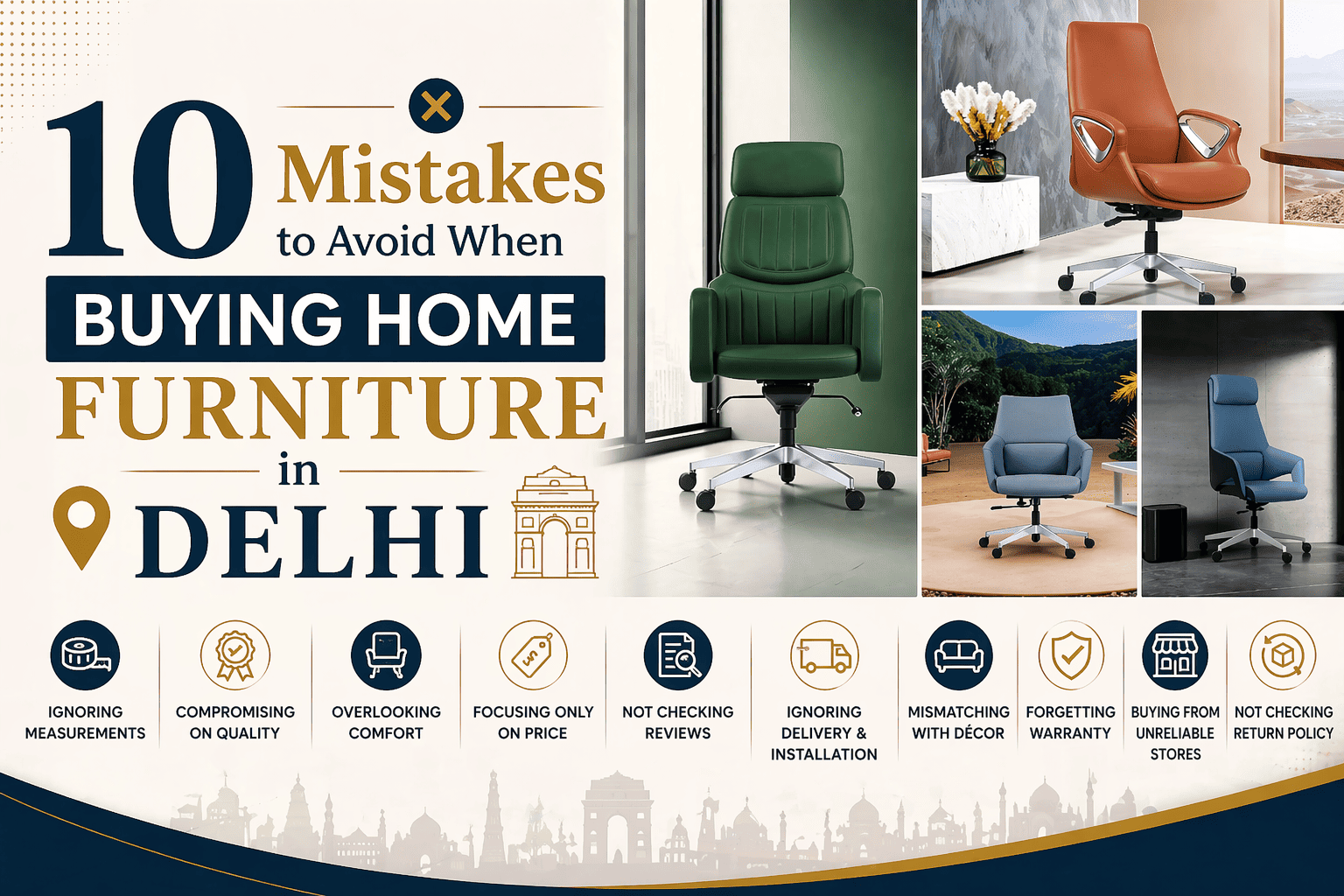
10 Mistakes to Avoid When Buying Home Furniture in Delhi
Introduction: Most Delhi Buyers Get This Wrong
Every year, thousands of Delhi residents spend significant money on home furniture — study chairs, home office setups, ergonomic seating — and end up with buyer’s regret within six months. The foam collapses. The hydraulic mechanism fails. The lumbar support that looked impressive in photos does nothing for their actual back.
It is rarely a budget problem. It is almost always a decision-making problem.
After 30 years of serving India’s most demanding furniture buyers, SeatKing has seen every mistake in the book. This guide documents the ten most costly ones — so you can avoid every single one of them.
Mistake 1: Judging a Chair by Its Appearance Alone
This is the most expensive mistake in the Delhi furniture market.
A chair can be beautifully upholstered in rich-looking leatherette, finished with polished chrome accents, and photographed against a lifestyle backdrop that makes it look like it belongs in a design magazine. None of that tells you anything about the foam density, the hydraulic quality, the structural integrity of the base, or the actual ergonomic support it provides.
In Kirti Nagar and across online platforms, the same visual language — high-back, leatherette, chrome base — is used across products ranging from ₹6,000 to ₹60,000. The difference is entirely internal. And internal quality is invisible until you sit in it for six hours, or until it fails three months later.
The fix: Always ask for specifications — foam density rating, hydraulic cylinder class, base material (nylon vs. aluminium), and weight capacity. A brand that cannot answer these questions is selling you aesthetics, not engineering.
Mistake 2: Skipping the Physical Test
For any study or home office chair above ₹15,000, never buy without physically sitting in it for at least 5–10 minutes.
Sit in your actual working posture. Adjust the height. Recline. Check whether the lumbar support makes contact with your lower back without you having to lean into it. Lift yourself slightly and feel whether the armrests adjust smoothly. Stand up and check whether the chair returns to position naturally.
What feels fine after 30 seconds of standing assessment will reveal its flaws after 5 minutes of actual sitting. Foam that feels plush initially will show its low density quickly under body weight. Lumbar pads that feel positioned correctly when you are consciously sitting straight will feel irrelevant the moment you relax into a natural posture.
The fix: Visit a showroom or request a product demonstration. For premium purchases, this is not optional — it is the most important step in the process.
Mistake 3: Buying the Wrong Size for the Room and the Table
This mistake is particularly common in Delhi homes where rooms are smaller than buyers remember when they are shopping.
A large high-back executive chair that looks magnificent in a showroom can overwhelm a 10×10 study room, make movement around the table difficult, and visually dominate a space to the point of making it feel claustrophobic. Similarly, a chair that is too small for the desk height creates awkward working angles that cause fatigue within hours.
The fix: Before shopping, measure your study room. Note the table height, the clearance between the table edge and the wall behind your chair, and the space available on either side. Bring these measurements with you when shopping — or input them when consulting with a brand’s team.
Mistake 4: Ignoring Total Cost of Ownership
Delhi buyers are trained to negotiate the purchase price. Almost no one thinks about the total cost of ownership — which is where the real financial story lives.
A budget study chair at ₹8,000 that needs replacement every 18–24 months costs ₹32,000–₹40,000 over five years — and delivers an inferior experience every single day of those five years. A premium ergonomic chair at ₹45,000 that performs for 8–10 years costs ₹45,000 over the same period — and actively supports your health and productivity throughout.
The premium option is genuinely cheaper over any meaningful time horizon. It just requires thinking beyond the initial invoice.
The fix: Calculate cost per year and cost per working day before making any furniture decision above ₹10,000. The mathematics almost always favour the premium choice.
Mistake 5: Overlooking Lumbar Support Adjustability
Generic chairs sold across Delhi as “ergonomic” frequently include a fixed lumbar pad — a static protrusion built into the chair back at a single height. For the small percentage of users whose lower spine happens to align perfectly with that fixed position, it provides some benefit. For everyone else, it is useless or actively uncomfortable.
Genuine lumbar support is height-adjustable so it can be positioned precisely where your lumbar spine needs it — which varies by individual height, sitting posture, and even the height of the desk being used.
The fix: Before purchasing any chair marketed as ergonomic, confirm whether the lumbar support is fixed or adjustable. If it is fixed, ask whether it is positioned based on any ergonomic standard or simply placed aesthetically. The answer will tell you everything about whether the brand understands ergonomics or merely uses it as a marketing word.
Mistake 6: Prioritising Discount Over Quality
Delhi’s furniture market — both offline and online — runs frequent sales. “50% off,” “Clearance stock,” “Limited time offer.” These triggers are powerful, and they cause otherwise rational buyers to make purchase decisions they would never make at full price simply because the discount makes the transaction feel like a win.
A ₹6,000 chair discounted from ₹12,000 is still a ₹6,000 chair. The original price is often inflated specifically to make the discount appear significant. The quality of the product has not changed.
The fix: Shop on specification, not on percentage discount. Define your minimum quality requirements before you start browsing. Then find the best product that meets those requirements at the best available price — rather than letting price signals define your quality criteria for you.
Mistake 7: Buying Without Checking After-Sales Support
Furniture failure — a hydraulic cylinder that drops, a recline mechanism that locks, an armrest bracket that cracks — is not a question of if. It is a question of when and how easily it gets resolved.
Many furniture vendors in Delhi — particularly market vendors and generic online sellers — are effectively unreachable after the sale is complete. No registered warranty service. No replacement parts. No support contact that actually responds. The purchase transaction is the entirety of the relationship.
The fix: Before purchasing, specifically ask: How do I reach you if there is a problem? What is the warranty process? Is there an in-home service option? A brand that cannot answer these questions clearly is a brand that does not intend to support you after the sale.
SeatKing’s 24×7 WhatsApp chat support and manufacturer warranty coverage exist precisely because after-sales service is not a secondary feature — it is fundamental to what a genuine premium brand delivers.
Mistake 8: Buying All Furniture From One Generic Vendor
Delhi’s large multi-category furniture stores offer convenience — one stop, everything under one roof. The trade-off is that furniture specialisation becomes impossible at that breadth. A store selling sofas, dining tables, wardrobes, beds, and office chairs simultaneously cannot develop deep expertise in any single category.
For study and home office chairs specifically — where ergonomic engineering is the central value proposition — buying from a brand that specialises exclusively in premium seating produces consistently better outcomes than buying from a generalist.
The fix: For your study or home office chair, buy from a specialist. SeatKing has spent 30 years developing and refining premium ergonomic seating specifically — not as a category addition to a broader furniture catalogue, but as the core and only focus of the brand.
Mistake 9: Ignoring Material Suitability for Delhi’s Climate
This mistake hits hardest between April and September, when Delhi temperatures regularly exceed 40°C and homes without continuous air conditioning become genuinely difficult working environments.
Thick synthetic leather upholstery — which looks premium in showroom photographs — becomes noticeably uncomfortable in warm conditions. Heat builds at the contact points between your body and the chair surface. For students and professionals working through Delhi’s summer, this is not a minor inconvenience — it is a genuine concentration and comfort issue.
The fix: In Delhi’s climate, consider breathable mesh back options or genuinely ventilated leatherette that allows air circulation. If your study room has reliable air conditioning, this is less critical — but if you work without it during peak summer months, material breathability should be near the top of your specification list.
Mistake 10: Treating the Chair as the Last Priority
This is perhaps the most ironic mistake of all — and one of the most common. A Delhi family will spend ₹80,000 on a study table with beautiful wood inlay and a glass top, then purchase the cheapest available chair to place in front of it because “the table is the main piece.”
The table holds your books and your laptop. The chair holds you — for 8–10 hours every single day. Every hour of productive study, every important work call, every creative breakthrough happens in the chair. It is not supporting furniture. It is the centrepiece of your productivity environment.
The fix: In any study or home office setup, always allocate your highest single-item budget to the chair. The table can be simpler. The storage can be minimal. The chair must be excellent — because everything that matters happens in it.
Conclusion: Avoid These 10, Get It Right the First Time
Buying home furniture in Delhi does not have to be a gamble. Every mistake on this list is avoidable with the right information and the right buying approach.
The consistent thread running through every mistake above is the same: short-term thinking producing long-term problems. The right chair — purchased with specification clarity, physical assessment, and genuine brand accountability — pays back in better posture, better focus, and better work for years.
SeatKing has helped India’s most demanding professionals, institutions, and families get this right since 1993. The range, the expertise, and the support are available to you today.
Shop the full range: seatking.shop Call / WhatsApp: +91 8860057005 SeatKing — Where Every Chair Is a Throne.
- Best Office Chairs in Delhi for Long Working Hours September 29, 2026
- Buy Office Furniture in Delhi: Essential Tips for Businesses September 18, 2026
- Top Trends in Premium Office Furniture Delhi for Modern Workspaces September 10, 2026
- Best Office Chairs in Ludhiana for Long Working Hours July 26, 2026
- Top 10 Office Chair Stores in Delhi You Should Visit Before Buying July 10, 2026

Seatking is one of India’s leading office furniture companies, catering to diverse sectors such as government enterprises, public sector units, banks, corporate offices, and institutions.
COPYRIGHT 2025 © SEATKING. ALL RIGHTS RESERVED.