
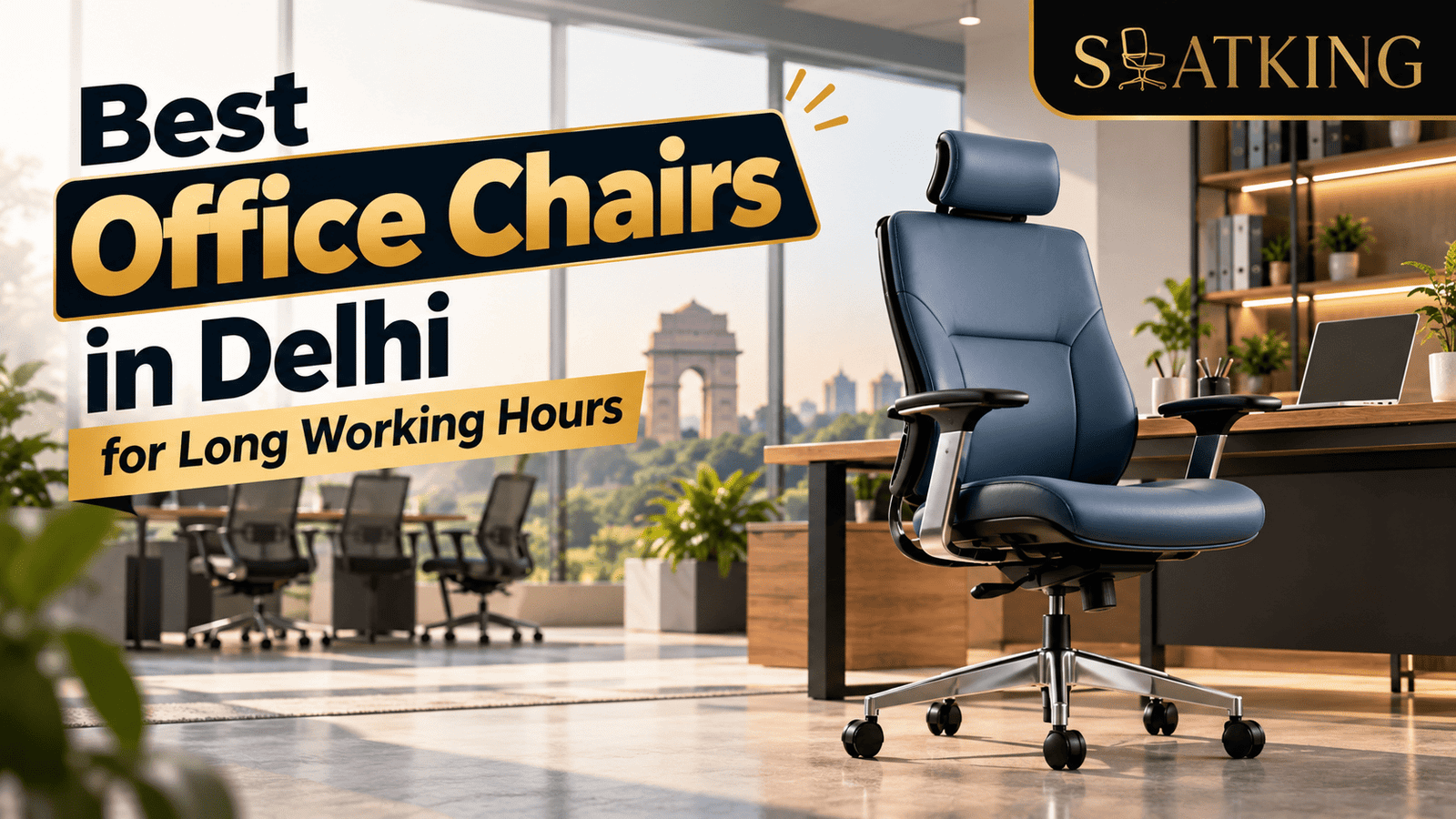
Best Office Chairs in Delhi for Long Working Hours
If you work eight, ten, or sometimes twelve hours a day at a desk, you already know how it feels by evening. Your lower back aches, your shoulders are tight, and getting up from the chair feels like a small workout. A lot of people in Delhi blame their job for this. More often, the problem is the chair.
At SeatKing, we talk to working professionals, startup founders, and home-office users across Delhi NCR every week. The same complaints come up again and again: “my back hurts after lunch,” “the cushion went flat in six months,” “the chair gets too hot in summer.” This guide brings together what we’ve learned from those conversations. It explains what makes a chair good for long hours and how to pick the right one for Delhi’s conditions.
Why Your Chair Matters More Than You Think
Sitting is not the problem. Sitting badly for a long time is. A poor chair pushes your pelvis backward, which flattens the natural curve of your lower spine. To stay upright, your back muscles work all day without rest. By evening they are tired, tight, and sore.
A good ergonomic chair supports your spine’s natural S-shape. It spreads your body weight evenly across the seat and lets you change position through the day. It won’t fix every posture habit, but it removes the biggest cause of daily strain.
What to Look For in an Office Chair for Long Hours
Before comparing brands or prices, know which features actually matter. Here’s what we check first when someone asks us to recommend a chair.
1. Adjustable Lumbar Support
This is the most important feature. Lumbar support should sit right in the curve of your lower back, roughly at belt level. Fixed lumbar pads work for some people, but an adjustable one (height, depth, or both) fits far more body types. If a chair has no lumbar support at all, skip it for full-day use.
2. Seat Height and Depth
Your feet should rest flat on the floor with your knees at about a 90-degree angle. Most people in India do well with a seat height range of roughly 16 to 21 inches. Seat depth matters too. When you sit all the way back, you should be able to fit two to three fingers between the seat edge and the back of your knee. A seat that’s too deep cuts circulation to your legs. One that’s too shallow leaves your thighs unsupported.
3. Recline and Tilt Lock
Sitting bolt upright all day is not ideal. A slight recline of 100 to 110 degrees takes pressure off your spinal discs. Look for a synchro-tilt mechanism, where the backrest and seat move together, and a lock that holds your preferred angle.
4. Armrests
Armrests that adjust in height (2D, 3D, or 4D) let your shoulders relax while typing. Fixed armrests that are too high push your shoulders up toward your ears, which is a common cause of neck pain.
5. Build Quality
This is where cheap chairs fail. Check three things:
- Gas lift class: A Class 3 or Class 4 gas cylinder is more durable and safer than the unrated cylinders found in budget chairs.
- Base material: A nylon or aluminium five-star base holds up far better than thin plastic.
- Foam density: High-density moulded foam keeps its shape for years. Low-grade foam goes flat within months.
Mesh vs Foam vs Leather: What Works Best in Delhi?
Delhi’s climate is harsh on furniture. Summers regularly cross 45°C, the monsoon brings heavy humidity, and dust is a year-round problem. Your upholstery choice matters more here than in milder cities.
Mesh chairs are the most practical choice for most Delhi users. Air flows through the backrest, so you don’t end up with a sweaty back in May and June, even with the AC running in a shared office. Good-quality mesh is also easy to dust. Our range of mesh office chairs is built for exactly this kind of daily use.
Foam and fabric chairs feel softer and warmer, which some people prefer in winter. They do trap heat, and fabric collects dust, so plan to vacuum them now and then.
Leather and PU leather chairs look premium and work well in cabins and boardrooms. Be careful with cheap PU, though. In Delhi’s humidity, low-grade PU can start peeling within a year or two. If you want the executive look, choose genuine leather or a high-grade PU. Our executive chair collection covers both options.
Types of Chairs to Consider
Not everyone needs the same chair. Here’s a simple way to narrow down your options.
For IT professionals and remote workers who sit 8+ hours daily, a fully ergonomic office chair with adjustable lumbar support, a headrest, and 3D or 4D armrests is worth the investment. You’ll use it more than almost any other piece of furniture you own.
For managers and business owners, a high-back executive chair gives you comfort and a professional look in the cabin. Make sure it still has proper lumbar support, because many executive chairs focus on looks over ergonomics.
For students and part-time users, a mid-back chair with basic adjustments is usually enough. Students often study for long stretches during exam season, so don’t skip lumbar support completely.
For offices furnishing many workstations, consistency and durability matter most. Buying in bulk from a single supplier makes servicing and replacements much easier later. If you’re setting up an office, our bulk office seating team can help you plan.
Budget Guide: How Much Should You Spend?
This is the question we hear most. A rough guide based on what we see in the Delhi market:
- Under ₹5,000: Fine for occasional use. Rarely good enough for full-time work. Expect basic height adjustment and not much else.
- ₹5,000 to ₹12,000: The sweet spot for most home-office users. You can find solid mesh chairs with lumbar support, recline, and adjustable armrests in this range.
- ₹12,000 to ₹25,000: Better mechanisms, 3D/4D armrests, adjustable seat depth, and better materials. Ideal for people who sit 10+ hours a day.
- Above ₹25,000: Premium ergonomic and executive chairs with high-end mechanisms and longer warranties.
Think about it this way. A ₹12,000 chair used for five years works out to about ₹200 a month, which is less than most people spend on a single dinner out. Compare that with the cost of physiotherapy for a back problem.
Mistakes People Make When Buying Office Chairs
From our experience with customers, these are the most common errors:
- Buying only by looks. A chair that looks stylish in photos can feel terrible after three hours.
- Ignoring the warranty. A long warranty on the mechanism and gas lift shows the seller trusts the product.
- Not adjusting the chair after buying it. Many people never touch the knobs and levers. Spend ten minutes setting up seat height, lumbar position, and armrests properly.
- Choosing a gaming chair for office work. Some gaming chairs are good, but many have a bucket-seat design that restricts movement and puts style ahead of lumbar support.
- Skipping the trial. Whenever possible, sit in the chair before you buy, or confirm the return policy.
How to Set Up Your Chair Correctly
Even the best chair won’t help if it’s set up wrong. Follow this quick routine:
- Adjust seat height so your feet rest flat and your knees sit at roughly hip level.
- Sit fully back in the seat and move the lumbar support until it fits the curve of your lower back.
- Set the armrests so your elbows rest at about 90 degrees with relaxed shoulders.
- Place your monitor at arm’s length, with the top of the screen at or slightly below eye level.
- Stand up and walk around for a few minutes every 30 to 45 minutes. No chair replaces movement.
Where to Buy the Best Office Chairs in Delhi
Delhi has plenty of options, from the furniture markets in Kirti Nagar to online marketplaces. The problem is that many sellers can’t tell you what gas lift class or foam density a chair uses. They simply don’t know.
When you’re looking for the best office chairs in Delhi, choose a seller who can answer technical questions, offers after-sales service in the city, and backs the product with a clear warranty. Local service matters. If a gas lift or mechanism fails, you want someone nearby who can fix it quickly instead of waiting weeks for a courier pickup.
At SeatKing, every chair we list is chosen with long working hours in mind. We focus on real ergonomic support rather than looks alone. You can browse all chairs online, or contact our team if you’d like help choosing based on your height, work hours, and budget.
Final Thoughts
The best office chairs in Delhi for long working hours aren’t always the most expensive ones. They’re the chairs that fit your body, suit Delhi’s climate, and are built to last through years of daily use. Prioritise adjustable lumbar support, a breathable backrest, a reliable gas lift, and a seller who will stand behind the product.
Your back carries you through every workday. A good chair is one of the simplest ways to look after it.
- Best Office Chairs in Delhi for Long Working Hours September 29, 2026
- Buy Office Furniture in Delhi: Essential Tips for Businesses September 18, 2026
- Top Trends in Premium Office Furniture Delhi for Modern Workspaces September 10, 2026
- Best Office Chairs in Ludhiana for Long Working Hours July 26, 2026
- Top 10 Office Chair Stores in Delhi You Should Visit Before Buying July 10, 2026

Seatking is one of India’s leading office furniture companies, catering to diverse sectors such as government enterprises, public sector units, banks, corporate offices, and institutions.
COPYRIGHT 2025 © SEATKING. ALL RIGHTS RESERVED.